
Soil Supplementation with Biochar Can Help Forests Take Root
Beyond compaction, former surface-mined lands suffer severe degradation that compromises soil health, including loss of organic matter, low nutrient availability, and disrupted microbial communities. These conditions challenge vegetation establishment, reduce water retention, and limit ecosystem benefits. For bareroot seedlings, survival is especially difficult during the first growing season, due to stressors such as drought, deer browse, transplant shock, competing vegetation, pests and disease, and poor planting stock.
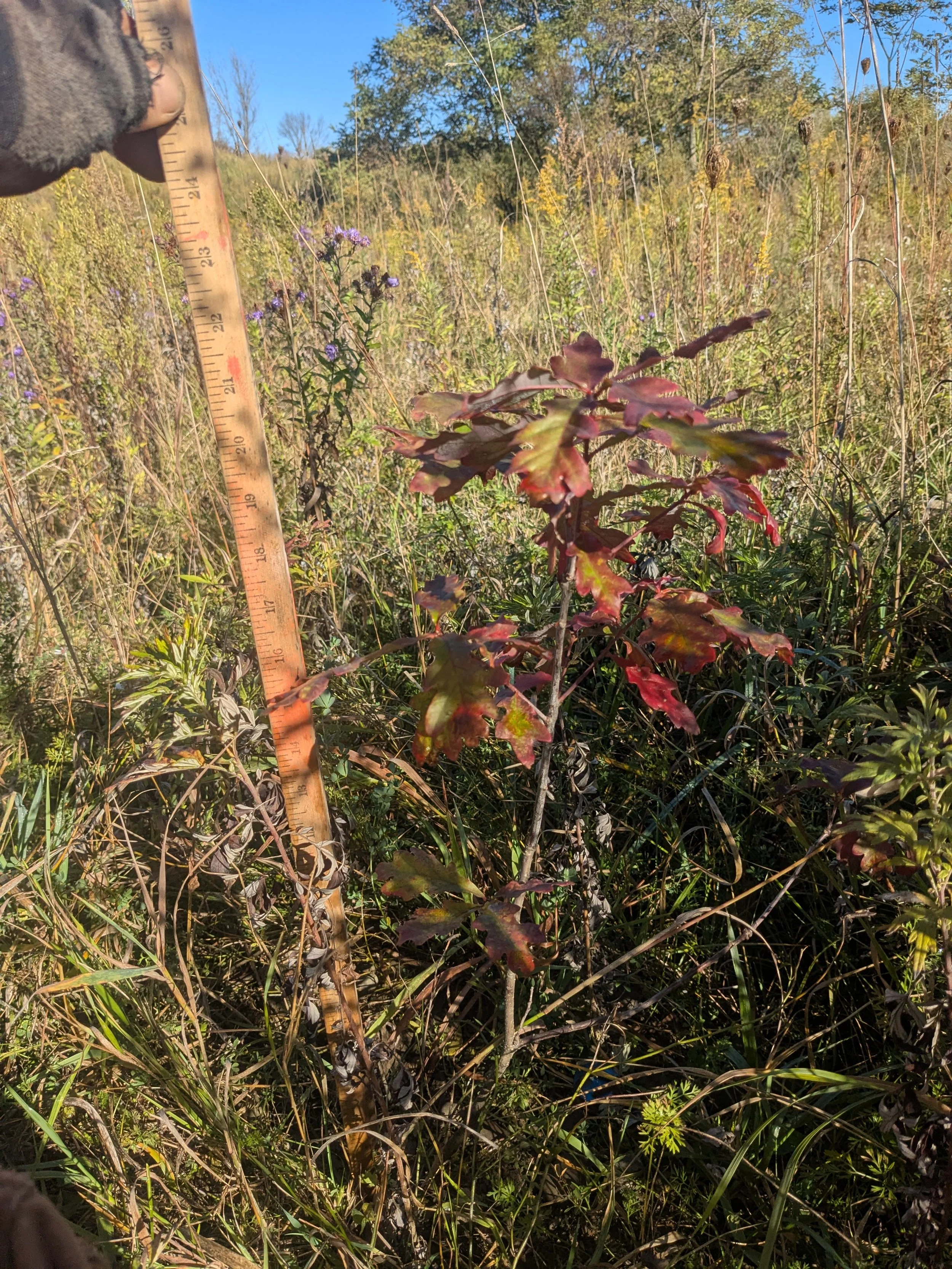
For these reasons, Bosland is investing in science-driven strategies to rebuild soil health and accelerate forest recovery. One approach includes the use of biochar, an economically viable amendment that can improve soil in challenging restoration environments. In mine soils, biochar has the potential to reduce compaction, increase water retention, improve nutrient cycling and root development; and provide long-term carbon storage.
Our Study Site
We undertook a field study to explore how using biochar derived from wood waste might impact seedling survival and long-term growth. Our test plot was a segment of the Lake Pleasant Conservation Area, on land that was once a gravel mine.
Reclamation at the site in Erie County, Pennsylvania was completed in May 2025. Our team and partners prepared the land by removing invasive plants, loosening compacted soil, and planting seedlings of native scarlet oak, white oak, and black locust at a density of 680 stems per acre. Throughout the study period, we evaluated biochar application rates, costs, and tree growth response.
To focus on areas most affected by past mining, we established randomized planting locations across three different landscape settings: flat areas, slopes, and low-lying bottomlands. Planting spots were randomly assigned to either a biochar treatment group (where biochar was incorporated into the planting hole) or a control group while accounting for differences in soil moisture, vegetation, and growing conditions.
The flat area was an open field with gravelly silt loam soils with relatively low vegetation competition. The slope area featured steeper terrain, dense vegetation, and soils containing concrete and other imported debris; competition from existing plants was greatest in this section. The bottomland area was relatively level but poorly drained, with consistently moist soils and a mix of grass and forbs.
Promising Results for Seedling Survival with Biochar
One year later, we evaluated the seedlings to determine survival, growth, and stressors.
Biochar supplementation improved first-year seedling survival, especially in locations where growing conditions were more challenging. Overall survival was high, increasing from 89.7% in the control plots to 93.7% in the biochar-treated plots. The greatest improvement occurred on slopes, where survival rose from 87.6% to 95.2%. Smaller increases were observed in bottomlands (90.3% to 93.1%) and flat ground (91.4% to 92.8%).
Tree species also responded differently. Scarlet oak showed the largest improvement, with survival increasing from 82.4% to 90.1%, while white oak experienced a more moderate increase from 91.7% to 95.0%. In contrast, black locust showed almost no change in survival (97.6% to 97.4%), likely because this hardy species was already well adapted to site conditions.
This study found that biochar can improve tree seedling survival, but its benefits vary by site and species. The greatest improvements occurred in stressful planting environments, particularly on slopes with limited soil moisture. The findings also suggest that biochar is most effective when targeted to difficult planting environments and moisture-sensitive species rather than applied uniformly across all sites.
The results also indicate that biochar may offer economic value despite increasing planting costs. Applying biochar during planting cost about $101 per acre, but higher first-year survival reduced the need for replanting, partially offsetting that expense. Better early survival can also help maintain higher tree densities over time, increasing future biomass production and carbon storage. If these benefits persist, the additional trees could contribute meaningful long-term carbon sequestration, providing both environmental and potential carbon-credit benefits.
Takeaways from Our Study
Based on these early results, Bosland plans to use biochar at future restoration sites with conditions similar to the slope microsites in this study, where competition from vegetation is high and soils have low water-holding capacity. We are also exploring its use at reclaimed coal refuse sites, where biochar could help slow water runoff and filter pollutants before they reach nearby waterways.
Beyond reforestation benefits, biochar production creates a market for low-value wood products and stores carbon in a stable form that can remain in soils for centuries. Although continued monitoring is necessary to confirm biochar’s long-term effectiveness, these advantages make biochar a promising tool for supporting forest restoration, improving site health, and contributing to long-term climate goals.
